
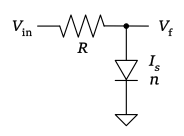
概要
ダイオードが直列抵抗を介して電圧源に接続されている場合、順方向電圧はあらかじめ決まった値にはなりません。 ダイオード電流はショックレーのダイオード方程式に従い、直列抵抗は電圧と電流の間に線形関係を加えます。 この結果、ダイオード電圧は超越方程式として表されます。
このカリキュレーターでは、SPICE で一般的に用いられている温度依存性飽和電流モデルを使用しています。 この方程式はランバート W 関数を用いて解析的に解くことができます。 ただし引数が非常に大きい場合には、指数項が倍精度の数値範囲を超える可能性があるため、 ニュートン・ラフソン法による反復計算に自動的に切り替えています。
順方向電圧 Vf カリキュレーター
このVf カリキュレータは、抵抗を介して電圧源に接続されたダイオードの順方向電圧を算出します。
直列抵抗を含むダイオードの式は、動作領域に応じて ランバート(Lambert)W 関数またはニュートン・ラフソン法を用いて数値的に解かれます。
Note: The calculation model used here does not take into account the backward diode components.
In the high current range exceeding several tens of mA, the results may differ significantly from the calculations.
In the high current range exceeding several tens of mA, the results may differ significantly from the calculations.
使用している数式
k : Boltzmann constant 1.380649 × 10⁻²³ [J K-1] (exact)
q : Elementary charge 1.602176634 × 10⁻¹⁹ [C] (exact)
Eg : Energy gap [eV]
N : Emission coefficient
T0 : Reference temperature [K] at which Is(T0) is specified.
T : Junction temperature [K] (= 273.15 + Tj).
XTI : Saturation current temperature exponent. Usually equal to 3 for junction diodes, 2 for Schottky barrier diodes.
q : Elementary charge 1.602176634 × 10⁻¹⁹ [C] (exact)
Eg : Energy gap [eV]
N : Emission coefficient
T0 : Reference temperature [K] at which Is(T0) is specified.
T : Junction temperature [K] (= 273.15 + Tj).
XTI : Saturation current temperature exponent. Usually equal to 3 for junction diodes, 2 for Schottky barrier diodes.
Temperature-dependent saturation current model:

The forward voltage can be expressed in closed form using the Lambert W function:

where:


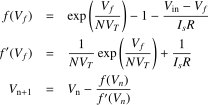
For large Vin (Vin > 220 N VT), the following Newton-Raphson method is used:
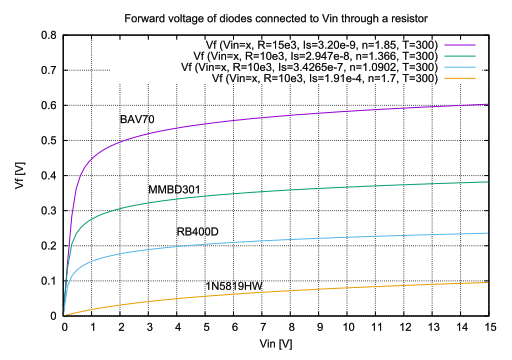
追補
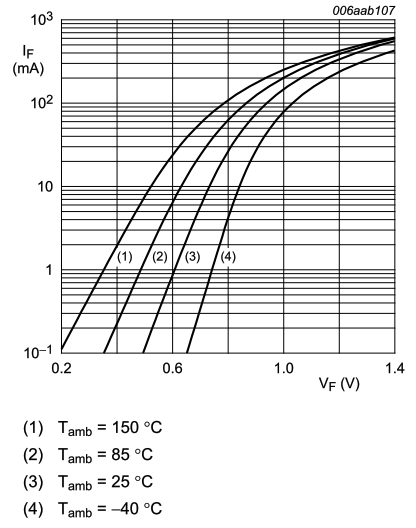
Forward current as a function of forward voltage; typcal values
資料(外部リンク)
- The SPICE Home Page (Berkeley)
- NIST — Fundamental Physical Constants
- Cree, XPEB, Xlamp XP-E2 series — High-power lighting-class LEDs
- Diodes Incorporated, 1N5819HW — 1.0A surface mount schottky barrier rectifier
- Hewlett Packard, Surface Mount Microwave Schottky Mixer DIodes Technical Data HSMS-8101 Single (OBSOLETED)
- Nexperia, BAV70 — High-speed switching double diode
- Onsemi, MMBD301L — 200 mA, 30 V, Schottky Diode UHF
- Onsemi, MMBD770 — 200 mA, 70 V, Schottky Diode UHF
- OSRAM, SFH4045N — 63 mW/sr (If = 70 mA), λpeak = 950 nm, IR chip LED
- Rohm, RB400D — 40V, 500mA, SOT-346, Schottky Barrier Diode
- Rohm, BAV70HY — 80V, 215mA, SOT-23, Cathode Common, Switching Diode
- Rohm, CSL1901 series — 0603-size LEDs Optimized for Low-current Low-light Chip Applications
- Rohm, SML-D12x8 series — Chip LEDs (Mono-color type)
- Rohm, RBR3LB30B — 3 A, 30 V, DO-214AA(SMBP), Low VF Schottky Barrier Diode
- Rohm, RBR3LB40C — 3 A, 40 V, DO-214AA(SMBP), Low VF Schottky Barrier Diode
- Rohm, RBR3LB60B — 3 A, 60 V, DO-214AA(SMBP), Low VF Schottky Barrier Diode
- STMicroelectronics, BAR43, 30 V, 100 mA, Vf 0.33 V @ 2 mA SMD General purpose Signal Schottky Diode
- Toshiba, 1SS154 — High frequency Schottky barrier diode, SPICE PARAMETER
- Toshiba, 1SS193 — Switching diode
- Vishay, SS34-E3, 3 A, 40 V, DO-214AB(SMC), Vf 0.5 V @ 3 A Surface-Mount Schottky Barrier Rectifier
関連項目
-
An implementation of Lambert W function and exponent of Lambert W function in C99
A technical note on the closed-form solution of the diode equation and practical implementation of the Lambert W function.